
Avia 2
Avia 2
Further Reach, Finer Details
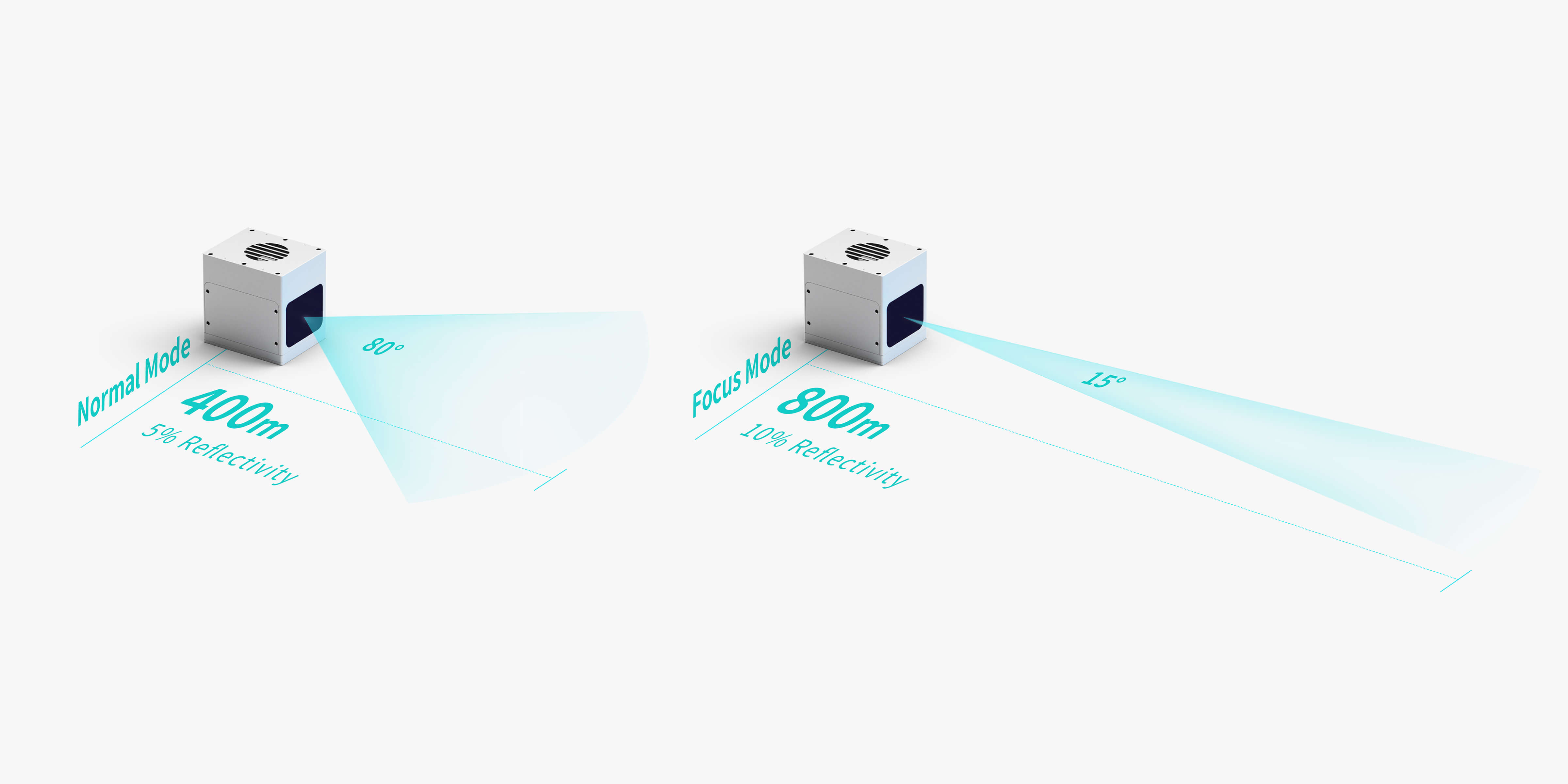
Normal: 400m@5%*
Focus: ≥ 800m@10%* Equivalent to approx. 600m@10%
Detection Range[2]0.25mrad × 0.25mrad [3]
Beam Divergence
Normal: 80° × 80°
Focus: 15° × 15°FOV
≤ 0.02°@1σ
Angular Precision
5–400 m: ≤ 4cm@1σ
400–700 m: ≤ 6cm@1σRange Precision
Est. 62,500 hrs [4]
MTTF
Ultra-Long Kilometer-Range Detection [2]
Small Beam Divergence for Extended Reach
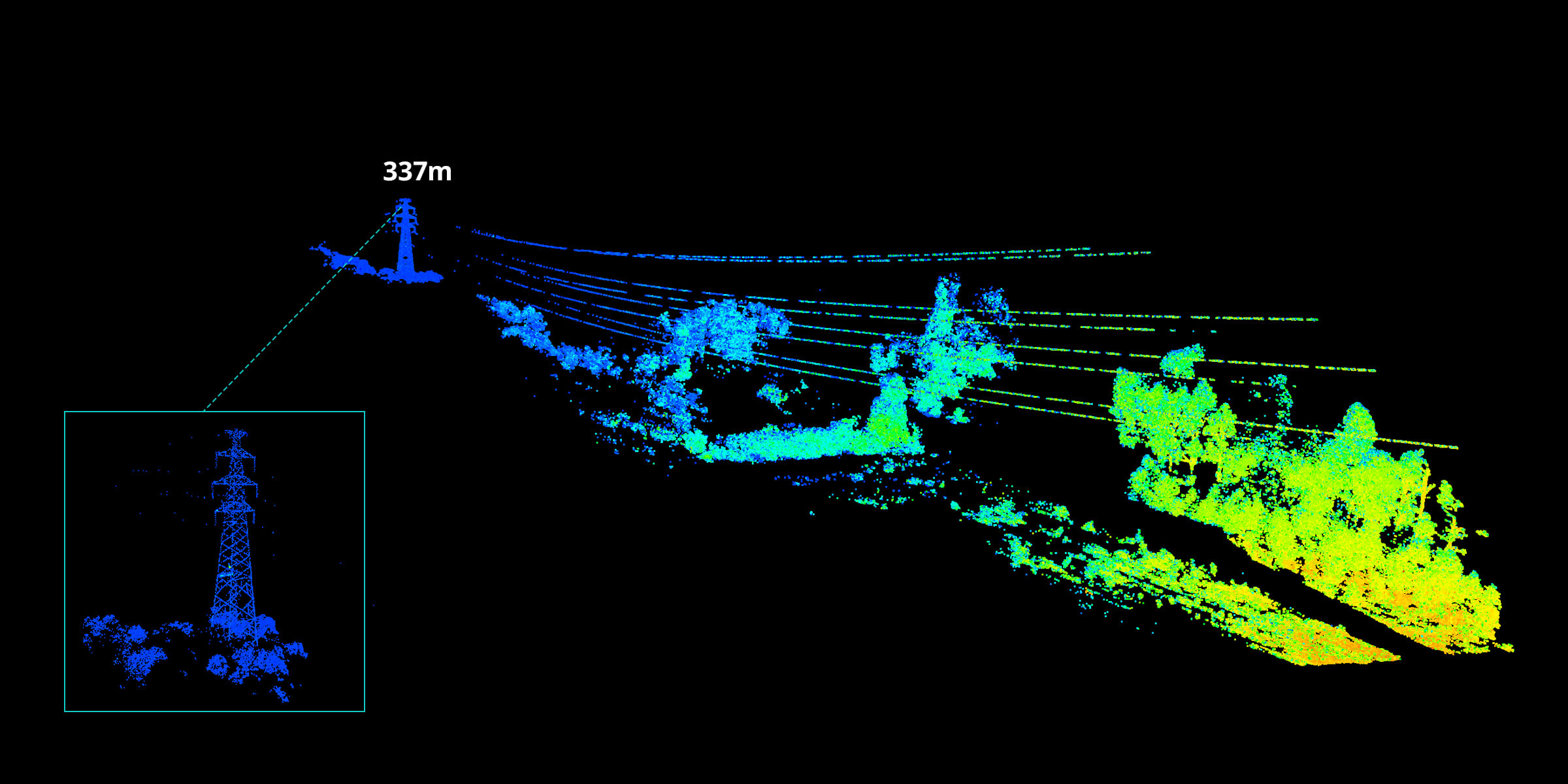
With a 0.25×0.25 mrad beam divergence, the spot diameter at 100m away is just 2.5 cm [3]. This concentrated energy ensures extended reach, accurately capturing tiny targets like power lines and branches from afar. It also penetrates dust and raindrop gaps to minimize noise, delivering highly detailed point clouds that boost algorithm development.
Rain and Fog Noise Removal Algorithm [5]
Avia 2 has rain and fog noise removal strategies. It uses high-precision sampling to identify signal features of interferences like raindrops, and easily filters out abnormal noise in rainy and foggy conditions. This increases point cloud usability, greatly reduces data processing load, and ensures stable all-weather operation.
Dual FOVs Adapted for Diverse Scenarios
The device also provides two FOV options: 80° × 80° in Normal mode for broader coverage, and 15° × 15° in Focus mode for longer detection range. Users can flexibly switch between them based on actual needs, which easily meets the detection requirements of various scenarios.
Durable Design and Low Maintenance Costs
Non-Repetitive Scan for Dense Coverage
Diverse Application Scenarios [7]
Power Line Security
In powerline inspection scenarios, a single Avia 2 unit can cover a span of up to one kilometer, greatly reducing deployment costs. Its micro spot helps accurately detect thin objects like wires, branches, crane arms, and cables. Combined with non-repetitive scanning, it provides rich point cloud details to accurately restore site conditions and reduce false alarms.
Wayside Condition Maintenance
Allows long-distance wayside monitoring and helps accurately detect small obstacles like rocks and branches even in complex weather. The 80° × 80° large FOV in Normal mode covers slopes on both sides of tunnel entrances and overhead catenary systems. Combined with non-repetitive scanning, it offers wide spatial coverage.
Bulk Material Volume Measurement
In high-dust and low-light environments like coal yards and granaries, the LiDAR effectively penetrates dust to capture high SNR signals, steadily outputting quality point clouds in harsh conditions. A single Avia 2 can cover ultra-large material piles, which facilitates automated inventory management with a cost-effective solution.
Smart Waterways
With its long range, one Avia 2 unit can cover massive waterways. Combining non-repetitive scanning with centimeter-level ranging accuracy, it captures highly consistent point clouds throughout a ship's transit. The rain and fog noise removal algorithm ensures stable output in complex weather, supporting safe all-weather operation of the waterways.
1. The 1535nm laser belongs to the broader 1550nm (1.5μm) eye-safe spectrum. It delivers equivalent physical properties, Class 1 eye safety, and long-range sensing capabilities to those of a 1550nm laser.
2. In Normal mode, Avia 2 has a maximum detection potential of 600 m at 10% reflectivity. However, to ensure a stable output of 350,000 points per second (350 kHz point rate), Avia 2 optimizes the balance between time of flight and measurement rate, and locks the cutoff range of this mode at 400 m to achieve higher point cloud density and consistency within commonly used ranges. In Focus mode, the maximum detection potential at 10% reflectivity reaches 800 m, and the cutoff range in this mode is 1000 m. The 1000m cutoff range is measured against a target with 20% reflectivity, and requires sufficient point cloud integration time depending on the target size in practical applications. Measured in a controlled environment. Results may vary depending on the environment and actual use.
3. The beam divergence is calculated in a laboratory environment by capturing the laser spot with an infrared camera and factoring in the test distance. The spot diameter at 100 m is a theoretical value derived from this divergence. Actual performance may vary slightly depending on ambient temperature and atmospheric conditions.
4. The 62,500 hours is a typical MTTF value calculated using a reliability formula and confidence level, based on high-temperature aging test results in a controlled environment. It does not represent the actual continuous operating time. Continuous operation in extreme environments with high temperature and humidity, or salt spray corrosion, may shorten the product's lifespan and potentially degrade its detection range and overall reliability.
5. The rain and fog noise removal feature includes two sub-functions: the rain noise removal function and the fog noise removal function. The rain noise removal function is only designed for light to medium rain and can effectively filter out most raindrop noise. Actual noise reduction results may vary depending on the environment. For weather conditions such as fog, haze, snow, and hail, please configure the rain and fog noise removal feature as needed based on the environment to achieve optimal results.
6. The ambient temperature range is measured in a controlled environment. The actual tolerance temperature and operating status during use may vary depending on specific on-site conditions (such as ventilation and sunlight). Please refer to the actual on-site conditions for performance.
7. During deployment and operation, please avoid pointing external strong lasers with a wavelength around 1535 nm directly at the LiDAR. Additionally, do not aim the LiDAR at highly reflective targets such as Low-E glass or corner cube retroreflectors at close range. This is to prevent high-intensity light waves from entering the receiver and causing permanent damage to the internal sensors.